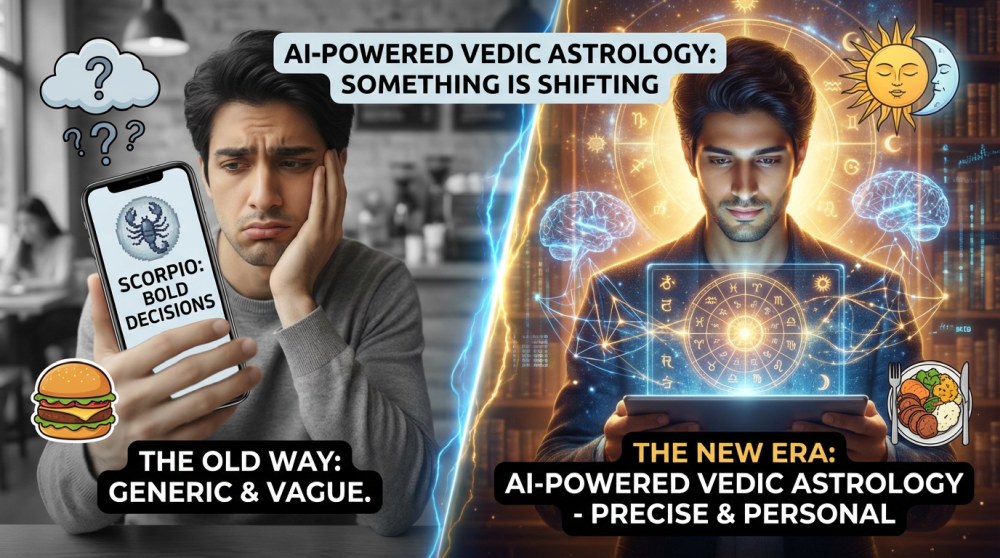
Why AI-Powered Vedic Astrology is Redefining Personal Growth
Introduction: Something Is Shifting
Picture this. You open a popular astrology app on a Tuesday morning. It tells you that because you are a Scorpio, today is a “good day for bold decisions.” So you send that risky email to your boss. You make a financial call you had been hesitating over. By evening, nothing has gone well. You close the app and wonder, why do I even bother?
Most people have been there. And most people quietly walk away from astrology feeling like it was never really meant for them. They dismiss it as vague, feel like it could apply to anyone, and move on.
But here is what those people may not know: what they experienced was not real astrology. It was a watered-down, one-size-fits-all summary. It was the nutritional equivalent of a fast-food meal compared to a home-cooked dinner made specifically for your body, your allergies, and your health goals.
Real astrology – specifically Vedic astrology, also called Jyotish – is an entirely different discipline. It is precise. It is personal. And today, thanks to the combination of modern artificial intelligence and thousands of years of cosmic wisdom, it is more powerful than it has ever been.
This article is going to walk you through exactly how AI-powered Vedic astrology works, why it is so different from what most people think of as “horoscopes,” and how it is genuinely changing the way people understand themselves, their relationships, and the timing of their most important life decisions.
The Problem With “Your Horoscope for Today”
Let us start with a simple question. Did you know that roughly 1 in 12 people on Earth share your Sun sign? That means if you are a Sagittarius, you share a zodiac sign with nearly 700 million other people. And yet, every daily horoscope column gives all 700 million of you the exact same message.
Does that seem precise to you?
Generic horoscopes are built on a single data point: your Sun sign. That is just the position of the Sun on the day you were born. It ignores everything else – where the Moon was, where Saturn sat, which house Mars ruled, what the exact degree of your rising sign is, or how all of these planets were talking to each other at the exact moment of your birth.
For centuries, this kind of broad-stroke astrology has been popular because it is easy to produce and easy to consume. Newspapers needed a column that could be written in five minutes and read in thirty seconds. Apps needed something clickable and shareable. The result is what we have today: an astrology that is more entertainment than insight.
This is not a criticism of people who enjoy those columns. There is nothing wrong with a fun, light read. But the problem comes when people judge all of astrology by that standard. They write off one of humanity's oldest and most sophisticated knowledge systems because the version they encountered was shallow.
The shift happening right now in the world of Jyotish is significant. Serious practitioners and technology developers are building tools that do away with generic interpretations entirely. The new standard is a birth chart that is unique to you – calculated with the precision of astronomical software, cross-referenced with multiple schools of astrological thought, and interpreted with the depth that used to require years of study or a highly skilled human astrologer.
This is the future. And it is already here. You can explore that approach in a modern Vedic astrology reading app.
What Makes a Vedic Birth Chart Different?
Before we dive into the technology, let us understand what makes Vedic astrology – and specifically the Vedic birth chart, called a Kundli – fundamentally different from what most Westerners think of as astrology.
The first and most important difference is the zodiac system. Western astrology uses what is called the Tropical Zodiac. This system is based on the seasons. Aries begins at the spring equinox, regardless of where the stars actually are in the sky. Over time, due to a slow wobble in Earth's rotation called the Precession of the Equinoxes, the Tropical Zodiac has drifted roughly 23 degrees away from the actual positions of the constellations.
Vedic astrology uses the Sidereal Zodiac. The word “sidereal” simply means “related to the stars.” The Sidereal Zodiac tracks the actual, real-time positions of planets against the backdrop of fixed star constellations. This is why many people who switch from Western to Vedic astrology discover that their Sun sign changes. Someone who thought they were a Taurus their whole life might find out they are actually an Aries in the Vedic system.
This is not just a technicality. It is a fundamental difference in philosophy.
Vedic astrology asks: where were the planets actually in the sky when you were born? The answer to that question is what your Kundli captures. And because it is anchored to real astronomical positions, Vedic practitioners argue – with a great deal of evidence – that it offers a more accurate cosmic blueprint.
But the Kundli goes far beyond just tracking planetary positions. A full Vedic birth chart includes:
- The Ascendant (Lagna): The zodiac sign rising on the eastern horizon at your exact birth time and place. This changes every two hours, which is why birth time matters enormously.
- Twelve Houses: Each house governs a different area of life – career, relationships, health, wealth, spirituality, and more.
- Nine Planets (Navagraha): These include the Sun, Moon, Mars, Mercury, Jupiter, Venus, Saturn, and two lunar nodes called Rahu and Ketu.
- Planetary Aspects and Conjunctions: How planets interact with each other and with specific houses.
- Divisional Charts (Vargas): Deeper sub-charts that zoom into specific life areas with extraordinary precision.
What you get from a proper Kundli is not a personality type. It is a multi-dimensional map of your life's tendencies, timing, and potential. No two charts are alike. Even twins born minutes apart can have slightly different charts that reveal meaningfully different life paths.
For a deeper practical experience, a free Vedic birth chart can help you see how this works in real time.
The Role of Planetary Data and the Swiss Ephemeris
So how do modern Vedic astrology tools actually calculate all of this? This is where things get genuinely exciting – and where the word “precision” starts to carry real weight.
The foundation of any accurate astrological chart is precise planetary data. You need to know exactly where every planet was – its exact degree, minute, and second of arc – at the moment of birth. Getting this wrong by even a small margin can shift house cusps, change divisional charts, and produce an inaccurate reading.
Modern Vedic astrology software relies on something called the Swiss Ephemeris. An ephemeris (the word comes from the Greek for “diary” or “journal”) is essentially a table that records the positions of celestial bodies over time. The Swiss Ephemeris, developed by Astrodienst in Switzerland, is considered the gold standard in the astrological computing world. It is based on the same planetary data used by NASA's Jet Propulsion Laboratory – one of the most rigorous astronomical research institutions on the planet.
Think about what that means. The same computational models used to plan the trajectories of space probes are also being applied to the calculation of your personal birth chart. The accuracy of Swiss Ephemeris data extends hundreds of years into the past and future, making it extraordinarily reliable for birth chart calculations dating back centuries.
The Swiss Ephemeris accounts for:
| Factor | What It Means |
|---|---|
| Planetary longitude | Exact degree position of each planet in the zodiac |
| Planetary latitude | Position above or below the ecliptic plane |
| Retrograde motion | When a planet appears to move backward from Earth's perspective |
| Ayanamsha correction | The adjustment applied to convert Tropical positions to Sidereal positions |
| True vs. Mean nodes | Different methods for calculating Rahu and Ketu positions |
The Ayanamsha deserves a special mention. This is the correction factor that converts a Tropical planetary position into a Sidereal one. There are multiple Ayanamsha systems used by different schools of Vedic astrology. The most widely accepted is the Lahiri Ayanamsha, which is officially recommended by the Indian government's calendar reform committee. Getting this conversion right is critical, and it is one of the reasons why older or simpler astrological tools often produce slightly inaccurate charts.
When a modern AI-powered Vedic astrology tool uses NASA-grade planetary data combined with the Swiss Ephemeris and the correct Ayanamsha, the result is a chart that is calculated with a level of precision that would have been impossible for human astrologers working by hand even a few decades ago.
Precision is not a luxury in this science. It is the foundation of everything.
How AI Thinks Like a Master Astrologer
Here is a question worth sitting with. What makes a master Vedic astrologer different from a beginner?
It is not just knowledge of the rules. Both may know that Saturn in the seventh house can create challenges in marriage, or that Jupiter in the ascendant brings wisdom and optimism. The difference is in synthesis. A master astrologer does not read one placement at a time. They read the entire chart as an interconnected system. They weigh contradictions. They notice when one planet's strength modifies another planet's weakness. They apply multiple layers of classical texts and cross-reference their interpretation until they arrive at a conclusion that is specific, nuanced, and meaningful.
This process is called iterative interpretation. It is the practice of cycling through layers of analysis again and again, each time refining the picture. It is also, interestingly, very similar to how advanced AI reasoning systems work.
Modern large language models (LLMs) – the kind of AI that powers today's most sophisticated astrology tools – are uniquely suited to this kind of layered analysis. They can hold enormous amounts of astrological knowledge in memory simultaneously. They can apply classical rules from ancient texts, weigh them against each other, note exceptions and special conditions, and synthesize a final interpretation – all within seconds.
But not all AI is created equal when it comes to astrology. The difference between a basic chatbot giving you generic planet descriptions and a truly advanced AI astrology system is enormous. The advanced system has been trained on:
- Classical Vedic texts like Brihat Parashara Hora Shastra and Brihat Jataka
- Hundreds of real chart interpretations from experienced astrologers
- Case studies that show how specific planetary combinations play out in real human lives
- The logic of multiple astrological systems (more on this in the next section)
- Contextual cues from the person asking – their age, gender, life situation, and specific questions
The AI is not just retrieving stored descriptions. It is reasoning through your chart the way a skilled astrologer would – by considering interactions, contradictions, strengths, weaknesses, and timing factors all at once.
Imagine asking a master astrologer about your career potential. They would not just look at the tenth house. They would look at the tenth house lord's placement, the planets aspecting the tenth house, the strength of your Lagna lord, your Dashas (planetary periods – which we will cover shortly), relevant divisional charts like the Dashamsha, and the overall pattern of your chart. They would synthesize all of that and give you a nuanced, specific answer.
That is exactly what the best AI-powered Vedic astrology tools are now doing – and they are doing it consistently, without fatigue, bias, or bad days. You can try that kind of personal reading for yourself.
Three Systems, One Deeper Truth
One of the most powerful aspects of advanced AI-driven Vedic astrology is its ability to work across multiple astrological traditions simultaneously. Traditionally, a practitioner would specialize in one school of thought. Today, the best digital tools merge three major systems to create a richer, more layered reading.
The three systems are Jyotish, Lal Kitab, and the KP System.
Jyotish is the classical Vedic astrology system, rooted in texts that are over 5,000 years old. It uses the Kundli, the nine planets, twelve houses, and an intricate system of planetary periods called Dashas. It is the most comprehensive and widely practiced system.
Lal Kitab – which translates to “Red Book” – is a fascinating and somewhat mystical branch of astrology that originated in the Punjab region of India in the early twentieth century. It was written in a poetic Urdu style and is said to have roots even older than its written form. Lal Kitab is famous for its unconventional remedies – simple, practical actions that are meant to balance planetary energies. Things like feeding birds, burying specific items, or changing certain habits. These remedies are highly specific to each planet's placement and are considered by many practitioners to be surprisingly effective.
The KP System, or Krishnamurti Paddhati, is a more modern development. Created by the Indian astrologer K.S. Krishnamurti in the mid-twentieth century, the KP System introduced an additional layer of sub-division within each nakshatra (lunar mansion) called sub-lords. The KP System is known for its extraordinary precision in predicting the timing of specific events. Where classical Jyotish might predict that a period is favorable for career growth, the KP System can narrow that down to specific months or even weeks.
When these three systems are used together and cross-referenced by AI, the result is a level of chart verification that is unprecedented.
Think of it like a medical diagnosis. A good doctor does not rely on just one test. They order bloodwork, imaging, and a physical examination, then synthesize all of that data. Similarly, a multi-system astrological reading does not rely on just one tradition's verdict. It looks for where all three systems agree – and that convergence points toward the most reliable truth.
| System | Strength | Best Used For |
|---|---|---|
| Classical Jyotish | Comprehensive life overview, Dasha timing | General life path, karmic themes |
| Lal Kitab | Practical remedies, simplified house analysis | Finding grounded, actionable solutions |
| KP System | Event timing precision | Pinpointing specific life events and windows |
This multi-layered approach is not something a single human astrologer could easily execute in a single sitting. It would take considerable time and expertise to fluently apply all three systems at once. AI does this seamlessly – and that is one of its greatest gifts to the field.
When Ancient Wisdom Meets Modern Psychology
Here is a truth that many traditional astrologers will readily admit: knowing what your chart says and knowing what to do with that information are two very different things.
A chart might show that a person has strong Rahu (the north lunar node) in their first house, suggesting a powerful drive for ambition, transformation, and sometimes obsession. A classical interpretation might describe this as a person of great desires who may struggle with identity and illusion. That is useful information. But what does it actually mean for how this person lives their life, handles relationships, and navigates emotional challenges?
This is where modern psychology and emotional intelligence become essential companions to ancient Jyotish wisdom.
The best AI-powered Vedic astrology tools do not stop at classical interpretation. They translate astrological patterns into psychological language that people can actually use.
For example, Mars in the twelfth house in classical texts is often described as causing “losses” or “hidden enemies” or even “expenditure in hospitals.” But what does that mean in everyday psychological terms? It might mean a person who suppresses their anger, channels aggression into private or hidden activities, and may struggle with feeling unseen or unheard. With that understanding, the person can begin to notice those patterns in their own behavior and work with them consciously.
Emotional intelligence (often abbreviated as EQ) is the ability to recognize, understand, and manage emotions – both your own and those of others. When AI interprets a Vedic chart through a psychological lens, it is essentially mapping astrological archetypes onto emotional and behavioral patterns. Saturn's influence might show up as difficulty with vulnerability. Venus's weakness might manifest as a fear of rejection. Ketu's placement might explain a person's deep spiritual pull alongside a sense of disconnection from the material world.
This kind of interpretation does not replace therapy. It complements it. It gives people a framework for self-understanding that is both ancient and deeply personal. And when presented with warmth, empathy, and practical clarity – as the best AI tools are designed to do – it can be genuinely transformative.
The goal is always the same: to take the cosmic blueprint and turn it into something actionable, compassionate, and growth-oriented.
Beyond “Points Matching” – Reimagining Kundli Compatibility
For generations, one of the most important uses of Vedic astrology has been Kundli matching – the practice of comparing two birth charts before marriage to assess compatibility. The most commonly used method is called Guna Milan (also known as Ashtakuta Milan), which literally means “matching of qualities.”
In Guna Milan, the charts of two people are compared across eight categories, and points – called Gunas – are assigned based on compatibility in each area. The maximum score is 36 points. Traditionally, a score of 18 or above is considered acceptable for marriage, and a score of 28 or above is considered very good.
The eight categories cover things like mental compatibility, emotional nature, health, loyalty, ego alignment, and basic physical compatibility. It is a thoughtful system, and it has served millions of families for centuries.
But here is the honest question: is 36 points enough to evaluate the full complexity of a modern relationship?
The answer, even among many experienced astrologers, is no – at least not on its own. Guna Milan is a starting point, not a conclusion. A couple can score 32 out of 36 in Guna Milan and still face serious relationship challenges because of factors that the system does not capture in full.
This is where AI-powered Kundli matching takes a significant leap forward. The best modern systems go beyond Guna Milan and layer in analysis of:
Emotional maturity indicators. How does each person's chart handle emotional stress? A Moon in Scorpio person and a Moon in Libra person may love each other deeply, but their emotional processing styles are very different. One dives inward and holds feelings tightly; the other seeks harmony and avoids conflict. Understanding this dynamic is crucial.
Communication styles. Mercury's placement and strength in both charts reveals how each person thinks, speaks, processes information, and handles disagreement. Two people with very different Mercury placements may love each other but constantly misunderstand each other – not out of bad intent, but simply because their communication styles are mismatched.
Venus and Mars dynamics. These planets govern love language, desire, and physical compatibility at a deeper level than Guna Milan captures.
Saturn overlays. When one person's Saturn falls in a sensitive spot of the other's chart, it can create a dynamic of restriction, obligation, or emotional heaviness. This is critical long-term compatibility data.
Navamsha cross-analysis. The Navamsha (D9) is a divisional chart specifically related to marriage and long-term partnership. Advanced AI systems compare both partners' Navamsha charts for deeper compatibility clues.
| Compatibility Factor | Traditional Guna Milan | AI-Enhanced Analysis |
|---|---|---|
| Mental harmony | Partially covered | Full Mercury and Moon analysis |
| Emotional maturity | Not covered | Moon, Saturn, and house analysis |
| Communication styles | Not covered | Mercury placement and strength |
| Long-term partnership | Basic scoring | Full Navamsha cross-reading |
| Timing of relationship milestones | Not covered | Dasha and transit synchronization |
This is not about replacing a beautiful tradition. It is about honoring it by making it more complete.
A couple who uses advanced AI Kundli matching comes away with not just a compatibility score, but a genuine understanding of their relationship's strengths, its potential friction points, and – importantly – what they can do about those challenges together. You can see this approach in a modern compatibility reading.
Dasha Periods and the Art of Perfect Timing
One of the most extraordinary – and least well-known – aspects of Vedic astrology is its system of Dashas. The word “Dasha” means “period” or “state.” The Dasha system is essentially a planetary calendar that runs through your entire life, assigning different ruling planets to different periods of time.
The most widely used system is called the Vimshottari Dasha, which operates on a 120-year cycle. Each of the nine planets rules a specific period ranging from six years (for the Sun) to twenty years (for Venus). Within each main Dasha period (called the Mahadasha), there are sub-periods called Antardashas, and within those are even finer subdivisions called Pratyantardashas.
The Dasha system is essentially a roadmap of your life's chapters.
If you are in a Saturn Mahadasha, you are in a period of discipline, hard work, lessons, and sometimes restriction. If you are in a Jupiter Mahadasha, it is a period of expansion, wisdom, opportunity, and growth. If you are in a Rahu Mahadasha, it is a time of ambition, transformation, and sometimes upheaval.
But here is what makes the system truly powerful: the Dasha periods are personalized to your exact chart. They are determined by the position of the Moon at your birth. Two people born on the same day but at different times may be in completely different Dashas. And because the ruling planet of your Dasha interacts with your unique chart, the way a Dasha expresses itself in your life is specific to you.
This is why timing in Vedic astrology is so remarkably precise. A good Vedic astrologer does not just say “2026 will be a good year for you.” They say “You are currently in your Venus Mahadasha, Jupiter Antardasha, which runs from March 2026 to June 2026. During this window, your seventh house of partnerships will be activated, and it is an excellent period to formalize commitments.”
That level of specificity is what changes lives.
Alongside Dashas, Vedic astrology offers another tool for precision timing: Muhurat. A Muhurat is an auspicious time window – a moment when the planets are aligned in a way that supports a specific type of activity. Getting married during a favorable Muhurat, signing a business contract during a strong Mercury transit, or starting a new venture during a supportive Dasha-Muhurat combination is a practice that has been part of Indian life for thousands of years.
AI tools can now calculate personalized Muhurats with extraordinary precision, factoring in your personal chart, the current planetary transits, and your specific intention. The result is not just a lucky time – it is a strategically aligned time that resonates with your individual cosmic blueprint.
Understanding Doshas and Finding Real Remedies
Every person's birth chart carries both strengths and challenges. In Vedic astrology, certain planetary configurations are called Doshas – a Sanskrit word that essentially means “fault” or “imbalance.” A Dosha does not mean your life is cursed or broken. It means there is a specific area of imbalance that requires awareness and, often, deliberate action.
The most commonly discussed Dosha is Mangal Dosha (also called Manglik Dosha). This occurs when Mars is placed in the first, fourth, seventh, eighth, or twelfth house of the birth chart. Mars is a fiery, aggressive planet, and when it sits in houses related to relationships and partnerships, it can create turbulence in marriage – conflict, power struggles, or in severe cases, disruption.
Other well-known Doshas include:
Kaal Sarp Dosha, which occurs when all seven main planets are placed on one side of the chart, between Rahu and Ketu. This configuration is associated with obstacles, karmic burdens, and recurring cycles of struggle – though it also often correlates with remarkable resilience and transformation.
Shani Sade Sati, which is a seven-and-a-half-year period when Saturn transits through the twelfth, first, and second houses from your natal Moon sign. This is considered a period of significant challenge, pressure, and inner transformation.
Pitra Dosha, associated with ancestral karma and often showing up as persistent, seemingly inexplicable patterns of suffering or missed opportunities.
Understanding your Doshas is not about fear. It is about informed navigation.
And this is where the classical texts become directly practical. Vedic astrology has always paired the identification of a Dosha with the prescription of a remedy – a Sanskrit concept called Upaya, meaning “solution” or “way out.”
Remedies in Jyotish are rooted in ancient texts and fall into several categories. They include Mantras (sacred sound repetitions that resonate with specific planetary energies), Gemstones (wearing specific stones said to channel planetary light beneficially), Charitable acts (donating specific items on specific days to honor specific planets), and Rituals or Pujas (sacred worship ceremonies to invoke divine planetary grace).
Lal Kitab, as mentioned earlier, adds its own layer of highly practical, accessible remedies – many of which involve simple daily actions rather than elaborate ceremonies.
The key distinction with AI-powered analysis is that remedies are not prescribed generically. They are matched specifically to your chart.
A generic website might tell every person with Mangal Dosha to wear a red coral gemstone. But a proper AI analysis will first assess the strength of Mars in your chart, whether Mars is a functional benefic or malefic for your ascendant, and whether the remedy is appropriate given your full chart picture. Getting this wrong is not just useless – it can sometimes make things worse.
The best AI systems present remedies that are:
- Rooted in classical textual authority (with references to the source texts)
- Cross-verified across multiple systems (Jyotish, Lal Kitab, and KP)
- Matched to your specific chart placements
- Practical and accessible for a modern lifestyle
- Accompanied by clear explanation of why the remedy is recommended
This combination of ancient wisdom and modern clarity is what makes AI-powered Vedic astrology not just intellectually interesting, but genuinely transformative for people's daily lives.
Why Deep Astrology Is Worth Serious Investment
Let us end with a conversation that often gets avoided in spiritual circles: the question of value.
There is a version of astrology that is free, fast, and everywhere. Daily horoscope apps, generic Sun sign readings, automated charts with single-paragraph descriptions. Most of it costs nothing. And most of it, if we are being honest, delivers very little.
Then there is deep, expert-modeled Vedic astrology – the kind that takes your exact birth data, calculates a precise chart using the best available astronomical tools, cross-references it across multiple classical systems, interprets it through both ancient wisdom and modern psychological insight, maps your Dasha periods, identifies your Doshas, and prescribes textually grounded remedies. This kind of reading can take a skilled human astrologer many hours to complete.
The question is not whether this kind of astrology is valuable. The question is whether you believe you are worth the investment.
Think about the decisions you face in your life. Choosing a career path. Entering a marriage. Starting a business. Navigating a health crisis. Deciding when to take a major risk and when to wait. These decisions shape the entire arc of your life. People spend tens of thousands of dollars on education, therapy, coaching, and financial planning to get these decisions right.
A deep, personalized Vedic astrological reading is not a replacement for those things. It is a complement to them – a cosmic layer of self-knowledge that helps you understand not just who you are and what you want, but why you are wired the way you are, what timing is most aligned with your goals, and what karmic patterns you may be unconsciously repeating.
People who take their life's purpose seriously deserve tools that take them seriously in return.
The rise of AI-powered Jyotish is making this depth of analysis more accessible than ever before. You no longer need to find, afford, and schedule time with a rare master astrologer – though human expertise will always have its irreplaceable place. You can now access a level of astrological intelligence that draws on thousands of years of wisdom, astronomical precision, and the interpretive power of advanced AI, and receive something genuinely meaningful from a deep Vedic astrology app.
This is not about belief in fate or surrendering your agency to the stars. It is the opposite. Vedic astrology, at its best, is a tool for self-mastery. It shows you the terrain of your life so that you can navigate it more consciously. It does not tell you what will happen; it tells you what tendencies are at work and what choices you can make to align with your highest potential.
The people who benefit most from deep Vedic astrology are those who approach it with curiosity, seriousness, and a genuine desire to grow. They are not looking for someone – or something – to tell them everything is going to be fine. They are looking for clarity, depth, and direction.
Conclusion: A New Era for an Ancient Science
Thousands of years ago, the sages who developed Jyotish were not just trying to predict the future. They were trying to understand the nature of time, karma, and human consciousness. They believed that the universe was not random – that there was a deep, intelligent order underlying all of existence, and that this order could be read in the movements of the planets.
That belief has endured across millennia, across cultures, and across countless generations of human beings who have looked at the night sky and felt that something up there was speaking to something down here.
What has changed today is not the wisdom. What has changed is our ability to access and apply it.
NASA-grade planetary data ensures that the foundation of every chart is astronomically accurate. The Swiss Ephemeris brings centuries of precision to birth chart calculation. Advanced AI reasoning brings the interpretive power of a master astrologer to anyone who seeks it. The integration of Jyotish, Lal Kitab, and the KP System brings multi-layered verification. And the bridge between ancient wisdom and modern psychology makes the insights actionable in real, daily life.
This is not astrology repackaged with a tech veneer. This is a genuine evolution – one that honors the depth of a 5,000-year-old science while making it available, precise, and transformative for the world we actually live in.
Whether you are trying to understand yourself more deeply, navigate a difficult life period, find the right timing for an important decision, or discover who you are truly compatible with – the cosmos has always had answers. We finally have the tools to hear them clearly.